How it works Who it helps Research Schools Add to Chrome →
✦ Free Chrome Extension · No Account Needed

Make any text
easier to
understand

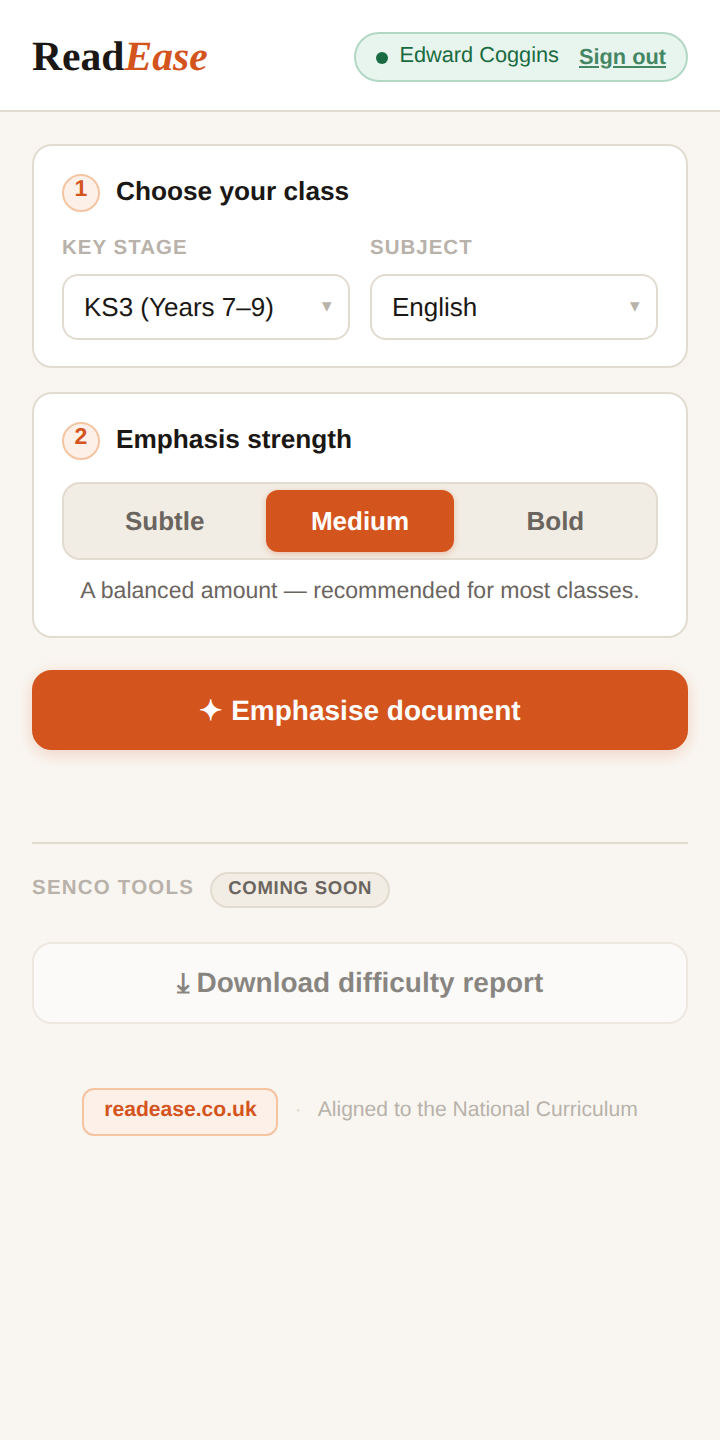
ReadEase uses AI to emphasise the most important words on any webpage — helping students with dyslexia, ADHD, and reading difficulties focus on what actually matters.

Before ReadEase
The mitochondria are membrane-bound organelles found in the cytoplasm of eukaryotic cells that generate most of the cell's supply of adenosine triphosphate used as a source of chemical energy.
✦ After ReadEase AI
The mitochondria are membrane-bound organelles found in the cytoplasm of eukaryotic cells that generate most of the cell's supply of adenosine triphosphate used as a source of chemical energy.
Free
Chrome Extension
5
Importance Levels
6
Subject Databases
AI
Claude-Powered Scoring
PDF
Upload & Format

Three steps to clearer reading

Install once, then ReadEase works invisibly on every webpage you visit.

01
Add ReadEase to Chrome
One click install from the Chrome Web Store. No sign-up, no account, no setup. Completely free.
02
Visit any webpage
ReadEase works automatically on educational content — articles, revision sites, online textbooks, any webpage with text.
03
Important words stand out
AI scores every word for importance and subtly emphasises the key terms across five tiers — so your brain processes them faster.

Built for every kind of reader

Reading difficulties affect one in five students. ReadEase levels the playing field without singling anyone out.

🧠
Students with dyslexia
Visual emphasis reduces cognitive effort, helping dyslexic readers process content more efficiently.
Students with ADHD
Important words act as visual anchors, making it easier to follow dense paragraphs to the end.
📚
Struggling readers
Clear visual hierarchy helps extract meaning even when reading fluency is limited.
🌍
EAL learners
Students in a second language can identify which unfamiliar words are worth looking up.

Not all words are created equal

Every word lands in one of five importance tiers. Subtle enough to read naturally — clear enough for the brain to notice.

the
Function word
found
Low importance
cells
Moderate
generate
Important
mitochondria
Critical

Trained on your curriculum

Each subject has its own AI-trained database — science vocabulary is scored differently from history or maths.

Get new features first

We're adding school dashboards, class management, and more.

No spam. No sharing. Unsubscribe any time.

Built on proven science

ReadEase is grounded in peer-reviewed research on visual attention and reading. Our formatting is calibrated to established findings about how the eye processes emphasised text.

👁️
Eye Movement Research
Eye movement research shows that typographic emphasis creates visual anchors that guide where readers fixate. Emphasised words receive longer fixation duration, which can improve information retention during reading.
Rayner, K. (1998). Eye movements in reading and information processing. Psychological Bulletin, 124(3), 372–422.
🔤
Font Type for Dyslexic Readers
Sans serif, monospaced and roman font styles significantly improve reading performance for dyslexic readers compared to serif, proportional and italic fonts. This finding comes from eye-tracking studies with 48 participants with dyslexia.
Rello, L. & Baeza-Yates, R. (2013). Good fonts for dyslexia. Proceedings of ASSETS 2013, ACM.
⚖️
Preattentive Processing
Subtle typographic differences can be processed preattentively — meaning the brain registers visual differences before conscious awareness. ReadEase uses minimal weight and size changes designed to operate below the threshold of conscious detection.
Laarni, J. (2002). Effects of font format and text complexity on reading efficiency. Proceedings of NordiCHI.
🧠
Cognitive Load Theory
Visual cues in text can reduce working memory demands during reading by making semantic structure more apparent. This allows readers to allocate cognitive resources to comprehension rather than scanning for meaning.
Pammer, K. (2014). Visual factors in reading. Current Directions in Psychological Science, 23(1), 42–48.
Why AI emphasis matters
ReadEase uses Claude AI to score words for semantic importance rather than applying emphasis arbitrarily. Research shows that visual emphasis only helps comprehension when it aligns with genuine meaning — random emphasis can actually impair understanding. Our AI ensures that emphasised words genuinely matter to the text.

Bringing ReadEase to your school?

We offer school licences with shared databases, class management, and dedicated support for SEND coordinators.

Get in Touch →
🧩

Like what you see?

Add ReadEase to Chrome and get AI-powered reading support on every webpage — free.

Add to Chrome — it's free →
Takes 2 seconds · No sign-up needed